Buy too little cloth and your tailor has a problem nobody can fix, because the same roll may be gone by the time you go back for more. Buy too much and you’ve paid for offcuts. So how much fabric for a suit, a shirt or a kurta do you actually need? Less guesswork than you’d think, as long as you know two things: how wide the cloth is and what’s being made.
The figures below are the standard lengths the trade works with for an average adult build. Treat them as a starting point. Your tailor’s tape measure has the final word.
First, check the width
Fabric is sold by length, but its width decides how much length you need. Most suiting is woven about 150 cm wide (58 to 60 inches). Some shirting and ethnic fabrics come narrower, around 112 cm (44 inches) or even 90 cm (36 inches). The narrower the cloth, the more length you need, because pattern pieces can’t sit side by side.
Standard fabric lengths at a glance
| Garment | Fabric width | Length needed |
| Full-sleeve shirt | 150 cm (58 to 60 in) | About 1.6 m |
| Full-sleeve shirt | 90 to 112 cm (36 to 44 in) | About 2.25 m |
| Trousers | 150 cm | About 1.3 m (up to 1.5 m if tall) |
| Jacket or blazer | 150 cm | About 2 m |
| Two-piece suit | 150 cm | About 3.3 to 3.5 m |
| Three-piece suit | 150 cm | About 3.5 to 4 m |
| Two-piece suit with extra trousers | 150 cm | About 5 m |
| Kurta | Around 112 cm (44 in) | About 2.5 to 3 m |
| Kandura or dishdasha | 150 cm | Commonly cut at 3.5 m |
These are typical figures for an average build. Allow more for tall or broad wearers, longer jackets, wide-leg trousers and patterned cloth.
Suits: where most mistakes happen
A two-piece suit usually needs about 3.3 to 3.5 metres of 150 cm cloth. Add a waistcoat and you’re looking at 3.5 to 4 metres. If you’d like a spare pair of trousers, which is worth considering because trousers usually wear out before the jacket does, budget around 5 metres in total.
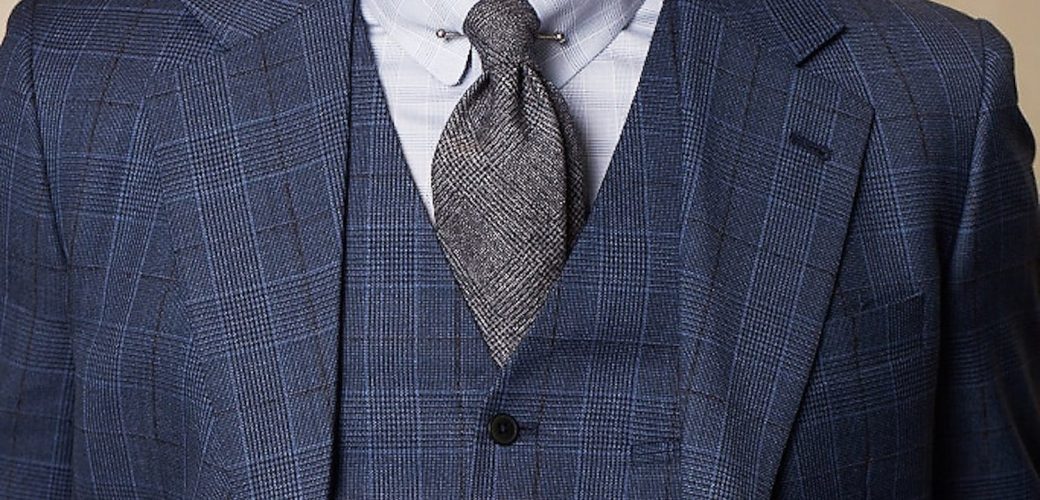
Checks, stripes and windowpanes need extra so the pattern lines up across seams, pockets and the back. Allow roughly an extra quarter to half a metre for patterned suiting. Plain cloth is the most economical to cut.
Shirts
For a full-sleeve formal shirt, 1.6 metres of 150 cm shirting is the standard cut. On narrower cloth, around 90 to 112 cm wide, you’ll need about 2.25 metres. Half-sleeve shirts take a little less, while larger sizes and longer shirt tails can need a little more.
Trousers
Around 1.3 metres of 150 cm fabric makes a pair of trousers for someone of average height. Tall wearers, pleated fronts or a wider leg can push that to about 1.5 metres.
Kurtas and kanduras
Kurta fabric is often woven narrower, and a standard kurta usually takes about 2.5 to 3 metres of cloth around 112 cm wide. Long, flared or heavily pleated styles need more, so check the design with your tailor first.
Kandura and dishdasha lengths are commonly cut at around 3.5 metres of 150 cm fabric. Height makes the biggest difference here because the garment runs to the ankle, so tall wearers should allow extra. If you’re still choosing the cloth itself, our guide to choosing dishdasha fabric covers comfort, climate and daily wear.
Ordering for uniforms or a collection
Bulk orders work differently. Garment makers plan the layout of pattern pieces for many garments at once, so the fabric used per garment is usually lower than for a single made-to-measure piece. For a uniform or production run, ask your garment maker for their consumption figure per garment and size, multiply it by the quantity, and add a small allowance for cutting loss and spares.
Order the full quantity from one lot if you can. Fabric from different dye lots can differ slightly in shade, and that difference shows when garments from two batches stand side by side. It’s one of the reasons we recommend choosing uniform fabrics that are regular, repeatable lines.
Habits that save money
Ask your tailor first
A good tailor can tell you exactly how much they need for your measurements and the design you want. That number beats any chart, including this one.
Buy slightly over, never under
A few extra centimetres cost far less than a remake, or a replacement panel that doesn’t quite match.
Check whether it needs pre-washing
Some cottons and linens can shrink on their first wash. Ask whether the cloth should be pre-washed before cutting, especially for shirts. Our comparison of linen and cotton explains how each one behaves.
Converting metres and yards
If your tailor or a pattern works in yards, one metre is about 1.09 yards and one yard is about 0.91 metres. So 3.5 metres is roughly 3.8 yards.
Aurora Textiles supplies suiting, shirting and ethnic fabrics wholesale from the Old Textile Market in Meena Bazaar, Dubai, for tailors, retailers and uniform makers. If you’re not sure how much to order, ask us before you buy.
Frequently asked questions
How many metres of fabric do I need for a suit?
About 3.3 to 3.5 metres of 150 cm wide fabric for a two-piece suit, and about 3.5 to 4 metres for a three-piece. Allow extra for patterned cloth or a tall or broad build.
How much fabric do I need for a shirt?
About 1.6 metres of 150 cm wide shirting for a full-sleeve shirt, or about 2.25 metres if the fabric is 90 to 112 cm wide.
How many metres of fabric do I need for trousers?
Around 1.3 metres of 150 cm fabric for someone of average height, rising to about 1.5 metres for tall wearers or wider styles.
Why do checked and striped fabrics need more length?
The pattern has to line up across seams, pockets and panels, so some fabric is used up positioning pieces to match. Allow roughly an extra quarter to half a metre for a suit.
How many yards is 3.5 metres?
About 3.8 yards. One metre is roughly 1.09 yards.